Getting the right foundation shade can make all the difference to your makeup look.
How to Find Your Perfect Foundation Shade 💄?
Finding the perfect foundation shade can completely transform your makeup look. The right foundation creates an even base, blends naturally into your complexion, and helps the rest of your makeup look smooth and polished. However, choosing the right shade can be challenging when there are so many colors, undertones, formulas, and finishes available.
A foundation that is too light can make your face look washed out, while a shade that is too dark can create an obvious contrast between your face and neck. Even if the depth of the shade is correct, the wrong undertone can make your skin look too yellow, pink, grey, or orange.
The good news is that finding your perfect match does not have to be complicated. Once you understand your skin tone, undertone, skin type, and the right way to test foundation, choosing a shade becomes much easier.
In this guide, we will explain how to find the perfect shade of foundation and share simple tips to help you find a natural-looking match.
Why Is Choosing the Right Foundation Shade Important?
Foundation is designed to even out your complexion while allowing your skin to look natural. When the shade matches properly, it should blend into your skin without creating a noticeable line.
A good foundation match can make your makeup look more seamless. It can also provide a better base for concealer, blush, bronzer, and other makeup products.
Choosing the wrong shade can have the opposite effect. A foundation that is too light may make your complexion look dull or ashy. A foundation that is too dark can make your face look disconnected from your neck.
The right foundation should look like your skin, only more even and polished.
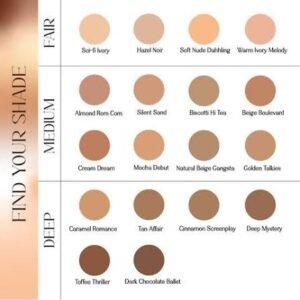
Step 1: Understand Your Skin Tone
The first step in choosing foundation is understanding your skin tone.
Skin tone refers to the overall color of your skin. It is commonly described as:
- Fair
- Light
- Medium
- Tan
- Deep
Your skin tone can change slightly throughout the year. Sun exposure, tanning, weather, and lifestyle can all affect how your complexion looks.
For example, your skin may become slightly deeper in tone during summer and appear lighter during winter.
Identifying your general skin tone gives you a starting point when looking at foundation shades. However, it is not enough on its own.
The next and equally important step is identifying your undertone.
Step 2: Identify Your Skin Undertone
Your undertone is the subtle color underneath the surface of your skin. Unlike your overall skin tone, your undertone generally remains consistent.
There are three main undertones:
Warm Undertones
Warm undertones usually have golden, yellow, or peachy tones.
If your complexion naturally looks golden or yellowish, you may have a warm undertone.
Foundations described as warm, golden, yellow, honey, or warm beige may work well for this type of complexion.
Cool Undertones
Cool undertones often have pink, red, or bluish tones.
If your skin tends to look rosy or pink, you may have a cool undertone.
Foundations described as cool, rosy, pink, or cool beige may be more suitable.
Neutral Undertones
Neutral undertones are a balance between warm and cool tones.
Your skin may not appear strongly yellow, pink, or golden. You may find that both warm and cool shades can work for you.
Neutral, beige, or balanced foundation shades can be a good starting point.
How to Check Your Undertone at Home
There are several simple ways to get an idea of your undertone.
Check Your Veins
Look at the veins on the inside of your wrist under natural light.
If they appear green, you may have a warm undertone.
If they look blue or purple, you may have a cool undertone.
If you see both colors or cannot clearly identify one, you may have a neutral undertone.
Look at Your Jewelry
Think about whether gold or silver jewelry looks more flattering against your skin.
If gold tends to complement your complexion, you may have warm undertones.
If silver looks more flattering, you may have cool undertones.
If both look equally good, you may have neutral undertones.
These tests are useful starting points, but they are not absolute. The most reliable method is still testing foundation shades directly on your skin.
Step 3: Don’t Test Foundation on Your Hand
One of the biggest foundation mistakes is testing the product on the back of your hand.
The skin on your hand can be a different color from your face and neck. As a result, a foundation that looks like a perfect match on your hand may look completely different once applied to your face.
Instead, test foundation on your jawline.
The jawline is one of the best areas to test because it helps you see how well the shade connects your face and neck.
Apply two or three shades next to each other. Blend each shade slightly and compare them.
The shade that seems to disappear into your skin is usually the closest match.
Step 4: Always Test Foundation in Natural Light
Lighting can dramatically affect the appearance of foundation.
Store lighting can make a shade look different from how it appears outdoors. Bathroom lights, warm bulbs, and even phone cameras can also change the appearance of color.
Whenever possible, check your foundation in natural daylight.
After applying the shade to your jawline, stand near a window or step outside.
Look at the foundation from different angles. Check whether it blends into your complexion or whether you can see a visible difference.
Natural daylight can help you identify whether the foundation is too yellow, pink, orange, grey, light, or dark.
Step 5: Consider Your Neck and Chest
Your face may not always be the same color as your neck.
Sun exposure, pigmentation, redness, skincare products, and other factors can cause differences between the face and the rest of the body.
This is why your goal should be to create a seamless transition.
When testing foundation, pay close attention to your jawline and neck. You want the foundation to look natural rather than creating a visible line between your face and neck.
If the foundation disappears into your jawline and creates a balanced appearance, you are likely close to your ideal shade.
Step 6: Choose Foundation According to Your Skin Type
Finding the correct color is important, but the formula you choose also matters.
A foundation can have a perfect shade but still look uncomfortable if it does not suit your skin type.
Foundation for Oily Skin
If you have oily skin, look for lightweight, matte, or oil-controlling formulas.
These foundations can help reduce the appearance of excess shine and may stay comfortable for longer.
Avoid applying too much product, as heavy layers can sometimes make oily skin look cakey.
Foundation for Dry Skin
If you have dry skin, a hydrating or dewy formula may be a better choice.
These formulas can provide a fresher appearance and may help prevent the foundation from emphasizing dry patches.
Preparing your skin with moisturizer before applying foundation can also help create a smoother base.
Foundation for Combination Skin
Combination skin has both oily and dry areas.
A natural or satin finish can be a good option because it provides a balanced appearance without being extremely matte or overly dewy.
You can also adjust your skincare and makeup application depending on the needs of different areas of your face.
Foundation for Normal Skin
If your skin is relatively balanced, you have more flexibility.
You can choose a foundation based primarily on your desired coverage, finish, and overall makeup style.
Step 7: Decide How Much Coverage You Need
Foundation comes in different coverage levels.
Light Coverage
Light coverage is ideal if you want a natural, everyday look.
It can help even out your complexion while allowing your natural skin to remain visible.
This is a great choice for people who prefer minimal makeup.
Medium Coverage
Medium coverage provides more evening than a lightweight foundation.
It can help reduce the appearance of redness, uneven skin tone, and mild pigmentation while still looking relatively natural.
Full Coverage
Full coverage is designed to provide a more complete finish.
It can help cover visible blemishes, pigmentation, and unevenness.
However, full coverage does not mean you need to apply a thick layer. Start with a small amount and build the product gradually where more coverage is needed.
Step 8: Choose the Right Foundation Finish
The finish of your foundation can influence the overall appearance of your makeup.
Matte Finish
Matte foundation gives the skin a smooth, shine-free appearance.
It can be particularly suitable for oily skin or anyone who prefers a polished, long-lasting makeup look.
Dewy Finish
Dewy foundation creates a fresh, radiant appearance.
It can work well for dry or normal skin and is a popular choice for people who enjoy glowing makeup.
Satin or Natural Finish
A satin or natural finish sits between matte and dewy.
It gives the skin a soft, balanced, skin-like appearance and can work well for everyday makeup.
When choosing a finish, consider both your skin type and your personal preference.
Step 9: Give the Foundation Time to Set
Some foundations may change slightly after application.
This is sometimes known as oxidation, where a foundation becomes darker or warmer as it settles.
Instead of immediately deciding that a foundation is your perfect match, give it a few minutes.
Allow the foundation to settle and then check the color again in natural light.
If it becomes significantly darker, orange, or warmer than you expected, try a different shade.
Step 10: What If You Are Between Two Shades?
Sometimes two foundation shades may both look close to your complexion.
If you are between two shades, choose the one that blends more naturally into your jawline and neck.
You can also mix two shades to create a customized match.
For example, you might use a slightly lighter shade during winter and mix it with a slightly deeper shade during summer.
Having two shades can be particularly useful if your complexion changes throughout the year.
Step 11: Consider Seasonal Changes
Your foundation shade may not remain exactly the same throughout the year.
During warmer months, your skin may become darker because of sun exposure. During colder months, it may appear lighter.
Instead of expecting one foundation to work perfectly every day of the year, consider having two shades that you can use separately or mix together.
This can make it easier to maintain a natural match as your complexion changes.
Step 12: Don’t Rely Only on Shade Names
Foundation shade names can be helpful, but they are not universal.
A shade called “Natural” or “Beige” can look completely different from one brand to another.
Even shades with the same name may have different undertones.
Instead of choosing a foundation only because the name sounds familiar, check its actual color and undertone.
If you are shopping in-store, test it on your jawline. If you are shopping online, use the brand’s shade guide and compare it with products you already know match your skin.
How to Find Your Foundation Shade Online
Buying foundation online can be more challenging because you cannot test the product beforehand.
Start by identifying your undertone and current skin tone.
Then look at the brand’s shade descriptions carefully. Some brands provide detailed information about whether a shade is warm, cool, or neutral.
If you already own a foundation that matches you well, use it as a reference. Some beauty retailers also provide shade-matching tools that can suggest similar shades across different brands.
Keep in mind that online photographs can look different depending on lighting and screen settings.
If possible, check the retailer’s exchange or return policy before buying.
Common Foundation Mistakes to Avoid
Avoiding common mistakes can make finding your perfect foundation much easier.
Don’t choose a foundation that is too light. A lighter shade does not automatically make your skin look brighter.
Don’t choose a shade that is too dark. If you want a warmer or bronzed appearance, use bronzer rather than choosing a darker foundation.
Don’t test only on your hand. Your jawline provides a much better indication of the correct shade.
Don’t rely only on artificial lighting. Always check your foundation in natural daylight.
Don’t forget your undertone. The depth of the shade may be correct, but the foundation can still look wrong if the undertone does not suit your complexion.
Don’t apply too much product. A heavy layer can make even the perfect shade look unnatural.
How to Make Your Foundation Look More Natural
Once you have found the right shade, application also matters.
Start with a small amount of foundation and blend it evenly across your face.
You can use a brush, sponge, or your preferred makeup tool.
Pay special attention to areas such as your jawline, hairline, nose, and around your mouth.
Build coverage gradually instead of applying a large amount at once.
If you need additional coverage, apply a little more product only where necessary.
This technique can help your foundation look lighter, smoother, and more natural.
Do You Need a Different Foundation for Different Occasions?
Not necessarily.
One foundation can work for everyday makeup and special occasions if you adjust the amount you use.
For daytime makeup, you may prefer a lighter layer for a natural appearance.
For an evening event, you can build the same foundation to provide more coverage.
The key is choosing a formula and shade that you genuinely like and that works well with your skin.
How to Know When You Have Found the Perfect Match
A good foundation match should meet a few simple requirements.
It should blend naturally into your jawline.
It should not make your face look noticeably lighter or darker than your neck.
The undertone should complement your natural complexion.
It should feel comfortable on your skin.
Most importantly, you should not be able to easily see where the foundation starts and your natural skin ends.
If the foundation appears almost invisible after blending, you have probably found a very close match.
Final Thoughts: How to Find Your Perfect Foundation Shade 💄
Learning how to find the perfect shade of foundation is much easier when you know what to look for.
Start by identifying your overall skin tone and understanding whether your undertone is warm, cool, or neutral. Instead of testing foundation on your hand, apply it along your jawline and check the result in natural light.
Don’t forget to consider your neck, skin type, coverage preference, and desired finish. If your skin tone changes with the seasons, keeping two shades can help you create a better match throughout the year.
Most importantly, don’t rush the process. Try different shades and formulas until you find one that feels comfortable and blends naturally.
The perfect foundation should enhance your complexion rather than completely change it. When you find the right shade, formula, and finish, your makeup can look smoother, more balanced, and naturally beautiful.
Remember, there is no single foundation shade that is perfect for everyone. Your ideal match is the one that works with your unique skin tone, undertone, and preferences. Take your time, trust what looks natural on your skin, and enjoy experimenting until you find your perfect match.